Global Top News This Week: The Biggest International Stories Shaping the World (Week Ending 26 July 2026)
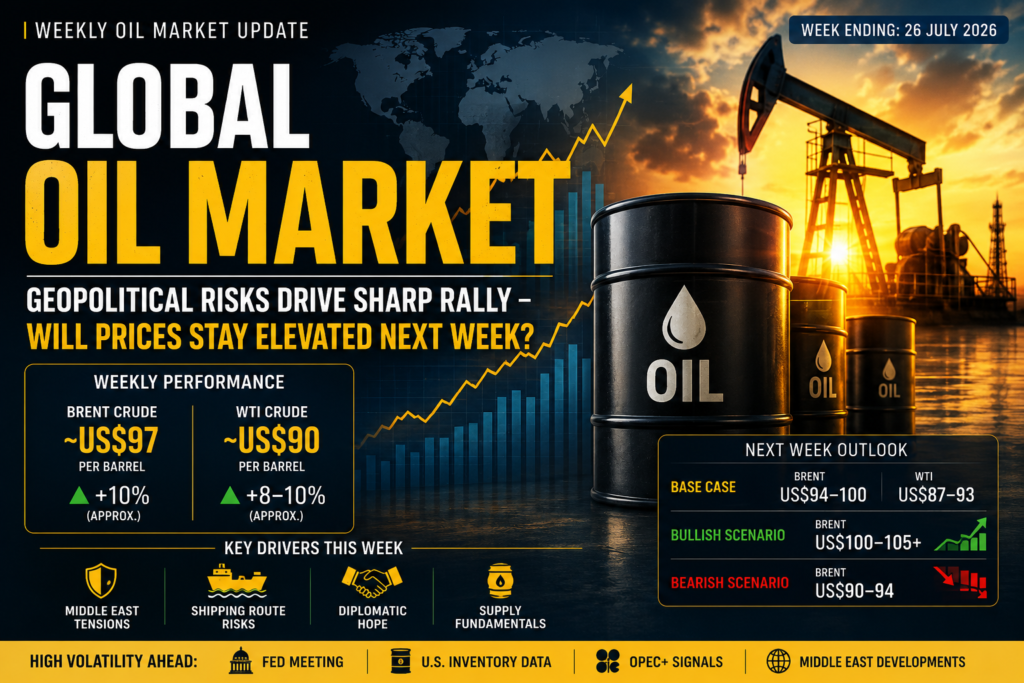
Global Oil Market Weekly Review: Geopolitical Risks Drive Sharp Rally — Will Prices Stay Elevated Next Week?

Major Drivers Behind This Week’s Price Rally
Global oil markets experienced one of their most volatile weeks of the year as escalating geopolitical tensions in the Middle East sent crude prices sharply higher before profit-taking and renewed diplomatic efforts trimmed gains toward the end of the week. Despite Friday’s pullback, both Brent and West Texas Intermediate (WTI) crude posted strong weekly gains, highlighting the market’s concern over potential supply disruptions.
The coming week is expected to remain highly volatile, with traders closely monitoring geopolitical developments, central bank decisions, U.S. inventory data, and OPEC+ production signals.
Weekly Oil Price Performance
Benchmark Weekly Close Weekly Change Brent Crude Around US$97 per barrel +10% (approx.) WTI Crude Around US$90 per barrel +8–10% (approx.) Brent briefly traded above US$100 per barrel during the week before retreating after reports of possible renewed diplomatic talks between the United States and Iran.
Major Drivers Behind This Week’s Price Rally
Global oil markets experienced one of their most volatile weeks of the year as escalating geopolitical tensions in the Middle East sent crude prices sharply higher before profit-taking and renewed diplomatic efforts trimmed gains toward the end of the week. Despite Friday’s pullback, both Brent and West Texas Intermediate (WTI) crude posted strong weekly gains, highlighting the market’s concern over potential supply disruptions.
The coming week is expected to remain highly volatile, with traders closely monitoring geopolitical developments, central bank decisions, U.S. inventory data, and OPEC+ production signals.
Weekly Oil Price Performance
Benchmark Weekly Close Weekly Change Brent Crude Around US$97 per barrel +10% (approx.) WTI Crude Around US$90 per barrel +8–10% (approx.) Brent briefly traded above US$100 per barrel during the week before retreating after reports of possible renewed diplomatic talks between the United States and Iran.
Middle East Tensions Continue to Shake Global Stability
The Middle East remains one of the world’s primary flashpoints.
Military confrontations involving Iran and regional allies have expanded beyond traditional conflict zones, affecting important shipping routes including the Red Sea. Analysts warn that prolonged instability could disrupt international trade and global energy supplies.
Several governments have increased naval deployments to safeguard commercial shipping while diplomatic efforts continue to prevent a wider regional conflict. The situation remains fluid, with markets reacting sharply to every new development.
Key Impacts
- Increased geopolitical uncertainty
- Higher global oil prices
- Shipping insurance costs rising
- Potential disruption of international trade
Europe Battles Historic Wildfires
Europe is experiencing one of its worst wildfire seasons in history.
France and Spain have evacuated hundreds of thousands of residents as massive fires continue to spread across drought-affected regions. Emergency services, military personnel, helicopters, and firefighting aircraft have been deployed in large-scale rescue operations.
Scientists continue to link the increasing frequency and intensity of extreme heatwaves and wildfires to long-term climate change.
Major Developments
- Massive evacuations across France and Spain
- Thousands of firefighters deployed
- Record hectares of forest destroyed
- Air quality warnings issued across several regions
Financial Markets Face Increased Volatility
Global stock markets experienced heightened volatility this week.
Technology stocks came under pressure as investors reassessed AI-related spending and awaited earnings from several of the world’s largest technology companies.
Investors are also focusing on upcoming central bank decisions, particularly from the U.S. Federal Reserve, which could significantly influence borrowing costs and global investment flows.
Market Trends
- Technology shares weakened
- Energy stocks outperformed
- Treasury yields increased
- Investors adopted defensive strategies
Extreme Weather Continues Across Asia
Several parts of Asia continue to face severe weather conditions.
Southern China is dealing with flooding risks following powerful storms, while authorities in affected coastal regions have issued emergency warnings and implemented evacuation plans.
Extreme weather events are increasingly affecting agriculture, transportation, and infrastructure throughout the region.
International Trade and Global Economy
Despite geopolitical uncertainty, global economic activity continues to show resilience.
Economists note that inflation trends, energy prices, supply-chain stability, and central bank policies remain the key drivers of the global economic outlook.
Businesses worldwide continue adapting to changing market conditions while monitoring developments in trade and energy markets.